

COSMOSIL Column List by Stationary Phase
| Sample | Separation Mode | Packing Material | USP Code | Stationary Phase |
Special Features and Applications |
|---|---|---|---|---|---|
| Organic Compounds (low M.W.) |
Reversed Phase |
3C18-EB |
L1 | Octadecyl Group |
- Excellent for basic compounds - 3 µm silica packing material |
| C18-MS-II | L1 | Octadecyl Group |
- Multi-purpose C18 column - Monofunctional silylation on ultra-pure silica gel for separation of the widest range of compounds |
||
| C18-AR-II | L1 | -Features strong acid resistance and suitable for acidic compounds and peptides | |||
| C18-PAQ | L1 | - Reversed phase column, compatible with 100% water based mobile phase. - Suitable for hydrophilic compounds |
|||
| Cholester | L101 | Cholesteryl Group |
- Usable under the same condition as C18 - Unique rigid cholesteryl structure improves separation |
||
| PBr | - | Pentabromobenzyl group | - Separate hydrohilic compounds in reversed-phase conditions | ||
| πNAP | - | Naphtylethyl Group |
- Stronger π-π interaction than Phenyl column | ||
| PYE | - | Pyrenylethyl Group |
- Most powerful π-π interaction | ||
| NPE | - | Nitrophenylethyl Group |
- Separation utilizing π-π interaction and dipole-dipole interaction | ||
| PBB-R | - | Pentabromobenzyl Group |
- Separation utilizing dispersion force | ||
| PFP | L43 | Pentafluorophenyl Group |
-Separation by dipole-dipole interactions. |
||
| CN-MS | L10 | Cyanopropyl Group |
- Great reproducibility using isocratic elution mode | ||
| C22-AR-II | - | Docosyl Group |
- Alkyl chain columns except C18column | ||
| C8-MS | L7 | Octyl Group |
|||
| C4-MS | L26 | Butyl Group |
|||
| TMS-MS | L13 | Trimethyl Group |
|||
| PE-MS | L11 | Phenylethyl Group |
- π-π interaction | ||
| Normal Phase |
SL-II | L3 | - | - Suitable for preparative separation | |
| Hydrophilic Interaction |
HILIC | L104 | Triazole | - Retains highly polar compounds that would not be retained in C18column | |
| Monosaccharides Oligosaccharides |
Hydrophilic Interaction |
Sugar-D | - | Secondary/Tertiary Amine | - Suitable for monosaccharides, oligosaccharides |
| NH2-MS | L8 | Aminopropyl Group |
- Primary amine bonded column | ||
| Proteins | Reversed Phase |
Protein-R | L1 | Octadecyl Group |
- Provides improved separation, high recovery rate, and acid resistance |
| C18-AR-300 | L1 | Octadecyl Group |
- Wide pore type reversed phase columns | ||
| C8-AR-300 | L7 | Octyl Group |
|||
| C4-AR-300 | L26 | Butyl Group |
|||
| Ph-AR-300 | L11 | Phenyl Group |
|||
| Proteins | Gel Permeation |
Diol-120-II | L20 | Diol Group | - Silica-based gel filtration column - Sample MW (Protein) 5,000-100,000 Da |
| Diol-300-II | - Silica-based gel filtration column - Sample MW (Protein) 10,000-700,000 Da |
||||
Diol-1000-II  |
- Silica-based gel filtration column - Sample MW (Water Soluble Polymer) 50,000 - 500,000 Da |
||||
| Ion-exchange | Type Q | Quaternary Ammonium Type | - Anion-exchange Type - For Purification - Target Sample: Acidic Proteins / DNA |
||
| Type Q-N | - Anion-exchange Type - For Ultra-fast Analysis, Precise Analysis - Target Sample: Acidic Proteins / DNA |
||||
| Type S | Sulfopropyl Type | - Cation-exchange Type - For Purification - Target Sample: Basic Proteins |
|||
| Type S-N | - Cation-exchange Type - For Ultra-fast Analysis, Precise Analysis - Target Sample: Basic Proteins |
||||
| Type M | Quaternary Ammonium Type/ Sulfopropyl Type |
- Amphoteric ion-exchange Type - For Purification - Target Sample: All Proteins |
|||
| Type M-N | - Amphoteric ion-exchange Type - For Precise Analysis - Target Sample: All Proteins |
||||
| Hydrophobic Interaction |
HIC | - | - | - Suitable for separation of peptide, and there is only a little less in enzyme activity and the teriary structure of proteins | |
| Fullerenes | - | Buckyprep | - | Pyrenylpropyl Group |
- Standard column for fullerene separation |
| Buckyprep-D | - | Nitro-carbazoyl Group | - Designed for separation of fullerene derivatives | ||
| Buckyprep-M | - | Phenothiazinyl Group |
- Designed to separate metallofullerenes | ||
| PBB | - | Pentabromobenzyl Group |
- Designed for preparative separation of C60, C70 | ||
| PYE | - | Pyrenylethyl Group |
- Separation of Fullerenes and structural isomers | ||
| NPE | - | Nitrophenylethyl Group |
- Separation of derivatived fullerene | ||
| Carbon Nanotubes |
Gel Permeation |
CNT | Hydrophilic Group |
- Separation of carbon nanotubes |
Selection Guide
Organic Compounds (Low M.W.)
Octadecyl group bonded column (C18ODS) are recommended as first-choice columns for separations of organic compounds (Low M.W.). If there is not enough separation or no retention using COSMOSIL C18 columns, COSMOSIL series offer many kinds of special columns.
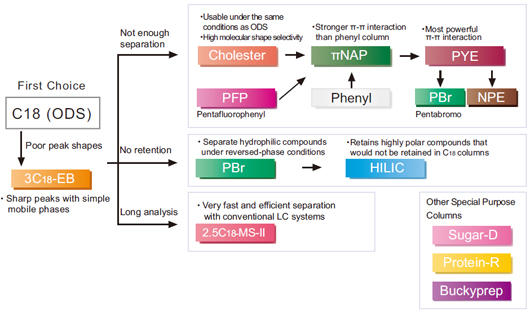
Please click here for the selection guide for C18 columns
Saccharides
- COSMOSIL Sugar-D is recommended for the separation of monosaccharides and oligosaccharides as a first-choice column.
- For the separation of sugar derivatives, COSMOSIL C18-PAQ is suitable as well.
Proteins
- Please select based on the separation mode.
Fullerenes
- COSMOSIL Buckyprep is most suitable for the separation of fullerenes.
COSMOSIL Specialty Columns
 COSMOSIL Specialty columns (PDF)
USP Specifications
The USP (U.S. Pharmacopeia) specifications are listed below with the recommended COSMOSIL HPLC columns.
| USP Code | Description | Recommended Columns |
|---|---|---|
| L1 | Octadecyl silane chemically bonded to porous silica or ceramic micro-particles, 1.7 to 10 m in diameter, or a monolithic rod |
COSMOSIL 3C18EB COSMOSIL C18-MS-II COSMOSIL C18-AR-II COSMOSIL C18-PAQ COSMOSIL C18-AR-300 COSMOSIL Protein-R |
| L3 | Porous silica particles, 5 to 10 µm in diameter | COSMOSIL SL-II |
| L7 | Octylsilane chemically bonded to totally porous silica particles, 1.7 to 10 µm in diameter | COSMOSIL C8-MS COSMOSIL C8-AR-300 |
| L8 | An essentially monomolecular layer of aminopropylsilane chemically bonded to totally porous silica gel support, 1.5 to 10 µm in diameter, or a monolithic silica rod. | COSMOSIL NH2-MS |
| L10 | Nitrile groups chemically bonded to porous silica particles, 3 to 10 µm in diameter | COSMOSIL CN-MS |
| L11 | Phenyl groups chemically bonded to porous silica particles, 1.7 to 10 µm in diameter | COSMOSIL PE-MS COSMOSIL Ph-AR-300 |
| L13 | Trimethylsilane chemically bonded to porous silica particles, 3 to 10 µm in diamete | COSMOSIL TMS-MS |
| L20 | Dihydroxypropane groups chemically bonded to porous silica particles, 5 to 10 µm in diameter | COSMOSIL Diol-120-II COSMOSIL Diol-300-II COSMOSIL Diol-1000-II |
| L26 | Butyl silane chemically bonded to totally porous silica particles, 3 to 10 µm in diameter | COSMOSIL C4-MS COSMOSIL C4-AR-300 |
| L43 | Pentafluorophenyl groups chemically bonded to silica particles by a propyl spacer, 1.5 to 10 µm in diameter | COSMOSIL PFP |
| L99 | Amylose tris-(3,5-dumethylphenylcarbamate), immobilized on porous, spherical, silica particles, 3 to 5 µm in diameter | COSMOSIL CHiRAL A |
| L101 | Cholesteryl groups chemically bonded to porous or non-porous silica or ceramic micro-particles, 1.5 to 10 µm in diameter, or a monolithic rod. | COSMOSIL Cholester COSMOCORE Cholester |
| L104 | Triazole groups chemically bonded to porous silica particles, 1.5 to 10 µm in diameter | COSMOSIL HILIC |
| L119 | Cellulose tris-(3,5-dichlorophenylcarbamate), immobilized on porous, spherical, silica particles, 3 to 5 µm in diameter | COSMOSIL CHiRAL C |