

COSMOSIL HPLC Accessories
- Cartridge holder, prefilter and connecting tube
- Ion pair reagents
- Labeling reagents
Cartridge holder, prefilter and connecting tube
>> For UHPLC (COSMOCORE) fittings and adapters, please see this page.
COSMOSIL Direct Cartridge Holder
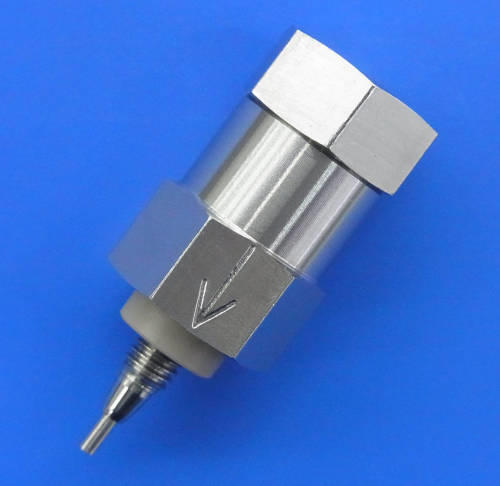
The Direct Cartridge Holder can be used instead of our older Guard Cartridge Holder. As it screws directly into the column, no connecting tube is required for connection to analytical column.
All guard cartridges are compatible with both the Direct Cartridge Holder and the older Guard Cartridge Holder, as long as the I.D. is the same.
| I.D. | Product No. | PKG size |
|---|---|---|
| 4.6 mm | 19989-71 | 1 PKG |
COSMOSIL Guard Cartridge Holder
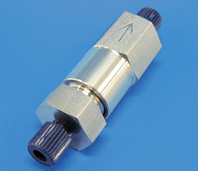
A Guard Cartridge Holder (or the above Direct Cartridge Holder) is required to use guard cartridges.
| I.D. | Product No. | PKG size |
|---|---|---|
| 2.0 mm | 11884-71 | 1 PKG |
COSMOSIL Column Prefilter
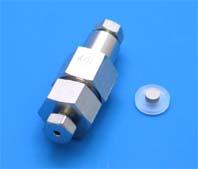
COSMOSIL Column Prefilter uses smaller pores (1 µm) than the column frit (2 µm).
| Product No. | PKG size |
|---|---|
| 39361-19 | 1 PKG |
Spare Filter for Prefilter
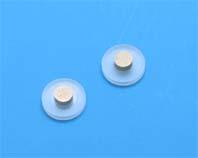
| Product No. | PKG size |
|---|---|
| 39539-09 | 2 PKG |
COSMOSIL Column Connecting Tube
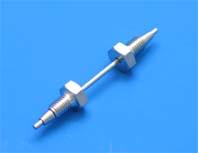
For connecting COSMOSIL columns.
| I.D. | Product No. | PKG size |
|---|---|---|
| 0.1 mm | 12570-41 | 1 PKG |
| 0.25 mm | 37843-69 | 1 PKG |
Ion pair reagents
The use of ion pair reagents as mobile phase additives extends the applicability of reversed phase HPLC. Ionic or highly polar compounds are difficult to analyze by reversed phase using only organic solvent and buffer solution because of the short retention time. Ion pair reagents are strong hydrophobic ions which form neutral ion pairs with oppositely charged samples molecules, making the efficient ODS columns amenable to separate ionic or highly polar samples.
Nacalai offers a broad range of ion pair reagents for pharmaceutical compounds and other highly polar materials.
When using ion pair regents, ample time should be allowed for establishing equilibrium and for cleaning the column. When using ion pair regents with an alkyl chain of C10 or shorter, it typically takes 20 minutes for establishing equilibrium and 30 minutes for cleaning. It may take more than 1 hour to clean the column when using ion pair reagents with an alkyl chain longer than C10. Therefore, it is highly recommended to prepare a column for exclusive use with ion pair reagents.
General use of ion pair reagents in the mobile phase
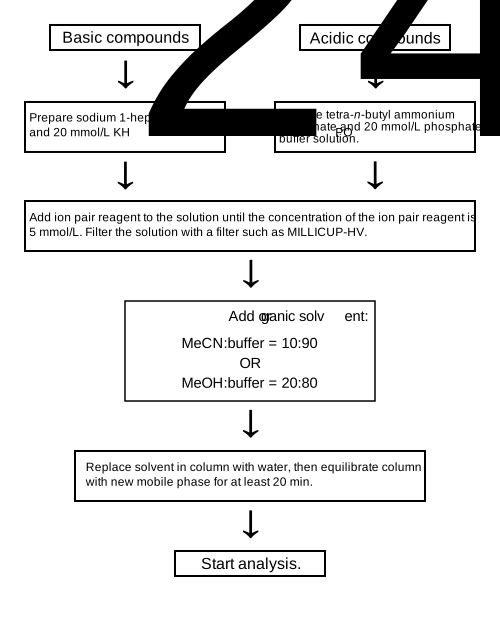
| Problem | Solution |
|---|---|
| Good peak separations but retention time is too long or too short. | Too long: increase organic solvent concentration by 10%. Too short: decrease organic solvent concentration by 10%. |
| Good retention time, but peaks are not sharply separated. | Use ion pair with longer alkyl chain, or the same ion pair using double the concentration. |
| No difference in separation when using ion pair, or no change occurs when trying the above solution. | For basic compounds, decrease pH. For acidic compounds, increase pH. |
| Retention time of the sample compound is too long. | Use ion pair of shorter alkyl chain or same ion pair of half concentration. |
Ordering information
for Basic samples
| Product Name | Grade | Storage | Product No. | PKG size |
|---|---|---|---|---|
| Sodium1-Butanesulfonate | SP | RT | 31331-94 | 5 g |
| Sodium1-Butanesulfonate (0.5M solution) | SP | RT | 31332-84 | 5 x 10 ml |
| Sodium1-Pentanesulfonate | SP | RT | 31730-64 | 5 g |
| 31730-22 | 25 g | |||
| Sodium1-Hexanesulfonate | SP | RT | 31529-24 | 5 g |
| 31529-82 | 25 g | |||
| Sodium1-Hexanesulfonate (0.5M solution) | SP | RT | 31532-64 | 10 ml |
| 31532-06 | 5 x 10 ml | |||
| Sodium1-Heptanesulfonate | SP | RT | 31528-34 | 5 g |
| 31528-92 | 25 g | |||
| Sodium1-Octanesulfonate | SP | RT | 31729-04 | 5 g |
| 31729-62 | 25 g | |||
| Sodium1-Octanesulfonate (0.5M solution) | SP | RT | 31733-34 | 10 ml |
| 31733-76 | 5 x 10 ml | |||
| Sodium1-Nonanesulfonate | SP | RT | 31626-44 | 5 g |
| Sodium1-Decanesulfonate | SP | RT | 31429-34 | 5 g |
| Sodium1-Undecanesulfonate | SP | RT | 32030-04 | 5 g |
| Sodium1-Dodecanesulfonate | SP | RT | 31426-64 | 5 g |
| Sodium Lauryl Sulfate | SP | RT | 31623-32 | 25 g |
for Acid samples
| Product Name | Grade | Storage | Product No. | PKG size |
|---|---|---|---|---|
| Tetra-n-butylammonium Bromide | SP | R | 32824-72 | 25 g |
| Tetra-n-butylammonium Chloride | EP | R | 32935-64 | 5 g |
| 32935-22 | 25 g | |||
| Tetra-n-butylammonium Hydrogensulfate | GR | RT | 32924-62 | 25 g |
| Tetra-n-butylammonium Iodide | SP | R | 32905-54 | 5 g |
| 32905-12 | 25 g | |||
| Tetra-n-butylammonium Perchlorate | SP | R | 32906-44 | 5 g |
| 32906-02 | 25 g | |||
| Tetra-n-butylammonium Phosphate | SP | R | 32929-54 | 5 g |
| Tetra-n-butylammonium Phosphate (0.5M solution) | SP | RT | 32926-26 | 10 ml |
| 32926-84 | 5 x 10 ml |
(Storage) RT: Room temperature, A: Cool and dark, R: Refrigerator, F: Freeze
Labeling reagents
Ordering information
| Product Name | Grade | Storage | Product No. | PKG size |
|---|---|---|---|---|
| Dansyl Chloride | SP | RT | 10427-91 | 1 g |
| p-Bromophenacyl Bromide (PBPB) | GR | R | 05802-92 | 25 g |
| 3,5-Dinitrobenzoyl Chloride (DNBC) | SP | A | 13530-44 | 5 g |
| N-(9-Acridinyl)maleimide (NAM) | SP | R | 00842-64 | 50 mg |
| NBD Chloride | SP | R | 24113-61 | 1 g |
| o-Phthalaldehyde (OPA) | SP | R | 27824-61 | 1 g |
| 27824-74 | 5 g | |||
| 27824-32 | 25 g |
(Storage) RT: Room temperature, A: Cool and dark, R: Refrigerator, F: Freeze
Labeling reagent for chiral separation of amino acids
L-FDVDA (1-Fluoro-2,4-dinitrophenyl-5-L-valine-N,N-dimethylethylenediamine-amide)
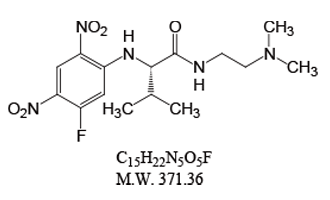
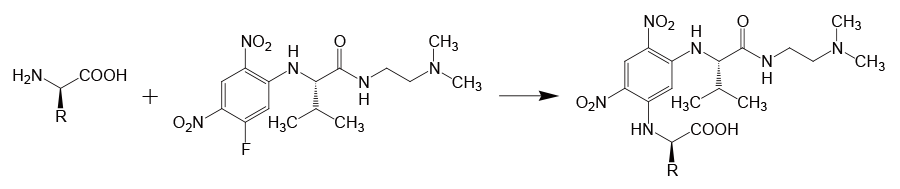
This product is a red to red-yellow crystal or powder that dissolves in acetone. It is a labeling reagent for amino groups and includes a chiral carbon, enabling the separation of labeled amino acids with a C18 or other achiral column (fig. 1). As the reagent itself is more easily ionizable compared to conventional products, higher sensitivity with LC-MS can be achieved (fig. 2), and it is suitable for analyzing trace amounts of peptides.
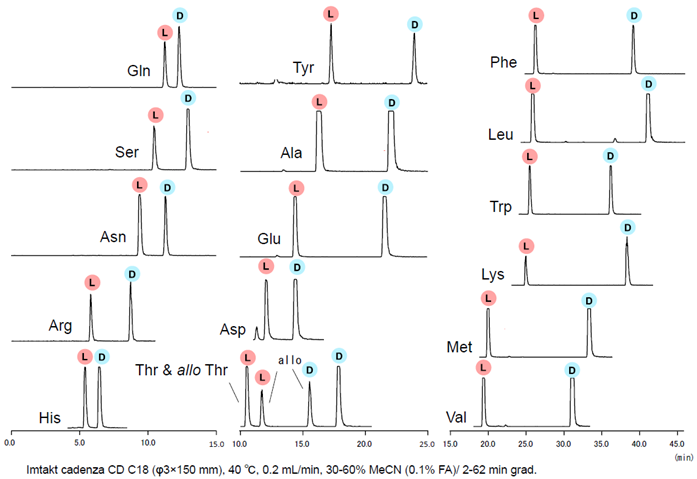
Fig. 1: Chiral separations of L-FDVDA-labeled amino acids
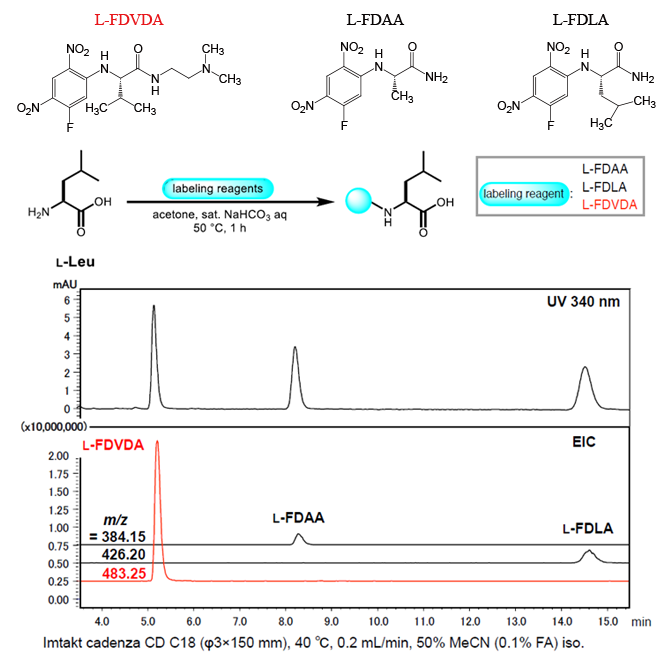
Fig. 2: Comparison of detection sensitivity using LC-MS
Data provided by Dr. Takefumi Kuranaga, Department of System Chemotherapy and Molecular Sciences, Division of Bioinformatics and Chemical Genomics, Graduate School of Pharmaceutical Sciences, Kyoto University
References
- Kuranaga, T.; Minote, M.; Morimoto, R.; Pan, C.; Ogawa, H.; Kakeya, H. ACS Chem. Biol. 2020, 15, p. 2499.
- Pan, C.; Kuranaga, T.; Cao, X.; Suzuki, T.; Dohmae, N.; Shinzato, N.; Onaka, H.; Kakeya H. J. Org. Chem. 2021, 86, p. 1843.
- Morimoto, R.; Matsumoto, T.; Minote, M.; Yanagisawa, M.; Yamada, R.; Kuranaga, T.; Kakeya, H. Chem. Pharm. Bull. 2021, 69, p. 265
- Jiang, Y.; Matsumoto, T.; Kuranaga, T.; Lu, S.; Wang, W.; Onaka, H.; Kakeya, H. J. Antibiot. 2021, 74, p. 307.
- Pan, C.; Kuranaga, T.; Kakeya, H. J. Nat. Med. 2021, 75, p. 339.
Ordering information
| Product Name | Grade | Storage | Product No. | PKG size |
|---|---|---|---|---|
| 1-Fluoro-2,4-dinitrophenyl-5-L-valine-N,N-dimethylethylenediamine-amide | SP | R | 20363-24 | 50 mg |
(Storage) RT: Room temperature, A: Cool and dark, R: Refrigerator, F: Freeze
Kyoto University has applied for a patent for this product, and Nacalai Tesque manufactures and sells it under license.